
Welcome to the MiM Music Circle
Introducing Music is Medicine:
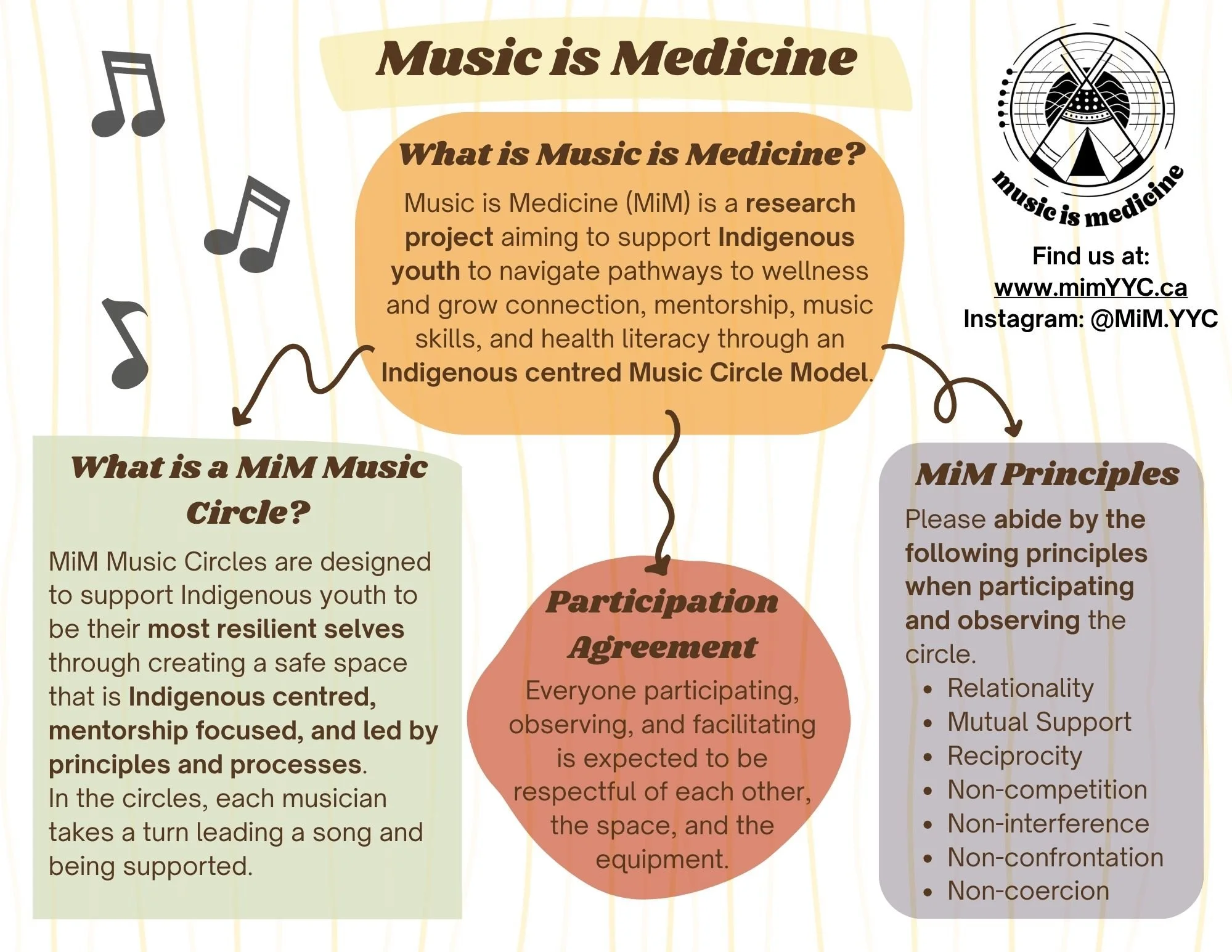
Music is Medicine (MiM) is an Indigenous music research project supporting Indigenous youth to navigate pathways to wellness and resilience through music-centred connection and mentorship within a music circle.
Getting Started:
This page provides an overview of the MiM music circles, describing shared practices and Ways of Being that help to create a welcoming and supportive space where everyone can participate, connect, and benefit. We invite you to read through this page to learn about MiM Music Circles, what you can expect, and how we can all contribute to making it a meaningful experience for everyone.
Please read through this page and return to the group with any questions.
What is a MiM Music Circle?
MiM music circles are centered around Indigenous ethics and involve shared practices and Ways of Being that create a welcoming and supportive environment. The music circle takes place bi-weekly in a community space, and is facilitated by host, co-host, and community musicians who act as musical support and mentors to Indigenous youth participants. When you arrive at a music circle, you can expect a warm welcome from the MiM band and other participants, followed by a shared meal, good conversation, and a MiM music circle.
Music can help us process our experiences, connect with one another, express ourselves, explore who we are, and support our wellbeing. In MiM music circles, we come together to share music in ways that are supportive, relational, celebratory, and non-competitive. By doing so, we aim to create an ethical space of engagement– a space where people can show up as their authentic selves, connect with others, and feel supported.
What is the MiM Music Circle Process?
-
After eating and chatting, it will be time for the music circle. We might transition to this portion of the evening with a shared game or activity, after which we will join one another in the circle. This is a good time to tune your instrument, organize your sheet music, and introduce yourself to any new musicians or catch up with those you already know.
If you do not feel ready to play in the circle, you are welcome to sit and support outside the circle until you feel ready to join. Everyone in and outside of the circle is a participant and has a responsibility to contribute to making a safe and fun space. Remember to be respectful of the music circle process no matter where you are sitting.
-
The host begins the circle by welcoming everyone, explaining the music circle process and protocols. If you have any questions, this is a great time to ask them.
The host begins the circle by leading the first song. They introduce the song and share the key and chord progression so that others can join in. The host may also share a reflection about the song or perhaps how they are doing, but sharing a reflection is always optional.
-
The circle then moves counterclockwise, beginning with the host, with each musician having the opportunity to lead a song.
When it is their turn, participants can:
Lead a song by introducing the key, chord progression, and any other information the group needs to join in. During a song, signal to other musicians to take a solo between song verses.
Share a reflection about their song or their experience, if they wish.
Pass if they do not wish to lead a song.
There is no expectation that anyone must lead. Passing is always welcome.
-
As each person leads their song, the group celebrates and supports them. This might include playing along, playing a solo when invited, or singing along when invited. The most important part of supporting the musician leading the song is listening or simply being present and encouraging.
The focus is not on performance or competition. Each person’s contribution is welcomed and celebrated.
-
The circle continues in this way until it is time to close. The host will lead the final song or invite someone else to do so.
Following the final song, the host may offer a few closing reflections before inviting everyone to pack up and leave the circle.
Music Circle Expectations:
Relationality: Recognizing relationship as central to the way we relate to one another, ourselves, the land, knowledge, community, and the world around us. Acting relationally means sharing responsibility and building trust and respect with one another.
Mutual Support: Supporting others and being supported by them in return. This looks like playing along and celebrating someone else’s song and having them do the same for you.
Reciprocity: Reciprocity is relationality in practice. It is a way of being in relationship that honours mutual benefit, care, and support. In the music circle, reciprocity can look like supporting someone as they bring a new song to the circle, just as they supported you when you introduced a new song. It is about building relationships where support is shared and carried forward over time.
Non-competition: Do not compete or compare to others in the circle.
Non-interference: Do not negatively interfere with others or their songs. Interference could be taking over, speaking or singing over the person leading the song, or purposefully disturbing or distracting others from a song.
Non-confrontation: Do not confront or criticize others in the circle for making mistakes. Do not embarrass or call-out anyone. If an issue needs to be addressed, the host will do so in a safe and private manner.
Non-coercion: Do not coerce others in the circle. This can look like pressuring someone to play or sing a song when they are uncomfortable doing so.
Everyone in the music circle is expected to be respectful of each other, the space, and the equipment. We ask that you abide by the following principles:
In a Music Circle, please DO:
Support others
Celebrate
Ask for help (e.g. ask for chords, strumming pattern, name of a song, a community musicians support for music or singing, etc.)
Reflect and share (e.g. share why you chose to play a song, something you are going through, how something made you feel, etc.)
Start from the beginning again
Ask for mentorship support
Share challenges
Be vulnerable
Be creative
Learn
Try your best
Be attentive
Stop and start again
Make other people feel comfortable
Have fun
In a Music Circle, please do NOT:
Interrupt
Criticize
Correct
Inappropriately laugh
Make someone uncomfortable
Disrupt
Interrupt
Antagonize
Tease
Feel ashamed of a mistake
Not try
Not listen
Be judgemental
Gossip
Talk about or share other people’s challenges, vulnerabilities, or personal information shared in the circle
MiM Music Circle Song Chart
To support musicians songs, or if you’d like to learn a music circle song for yourself, check out the MiM Song Chart!